FOR THE NON-BELIEVERS
Why are we like this?
We’ve seen one too many National Geographic videos. Somewhere along the way, we learned how bees make honey, and now we can’t look at the little squeeze bear the same way. Our stomachs have a pretty immediate opinion about it.
Maybe you watch the same footage and come away thinking bees are incredible. We think so too. We just reach for maple syrup. If you’re curious what got to us, pull up a chair.
Well, there goes breakfast.
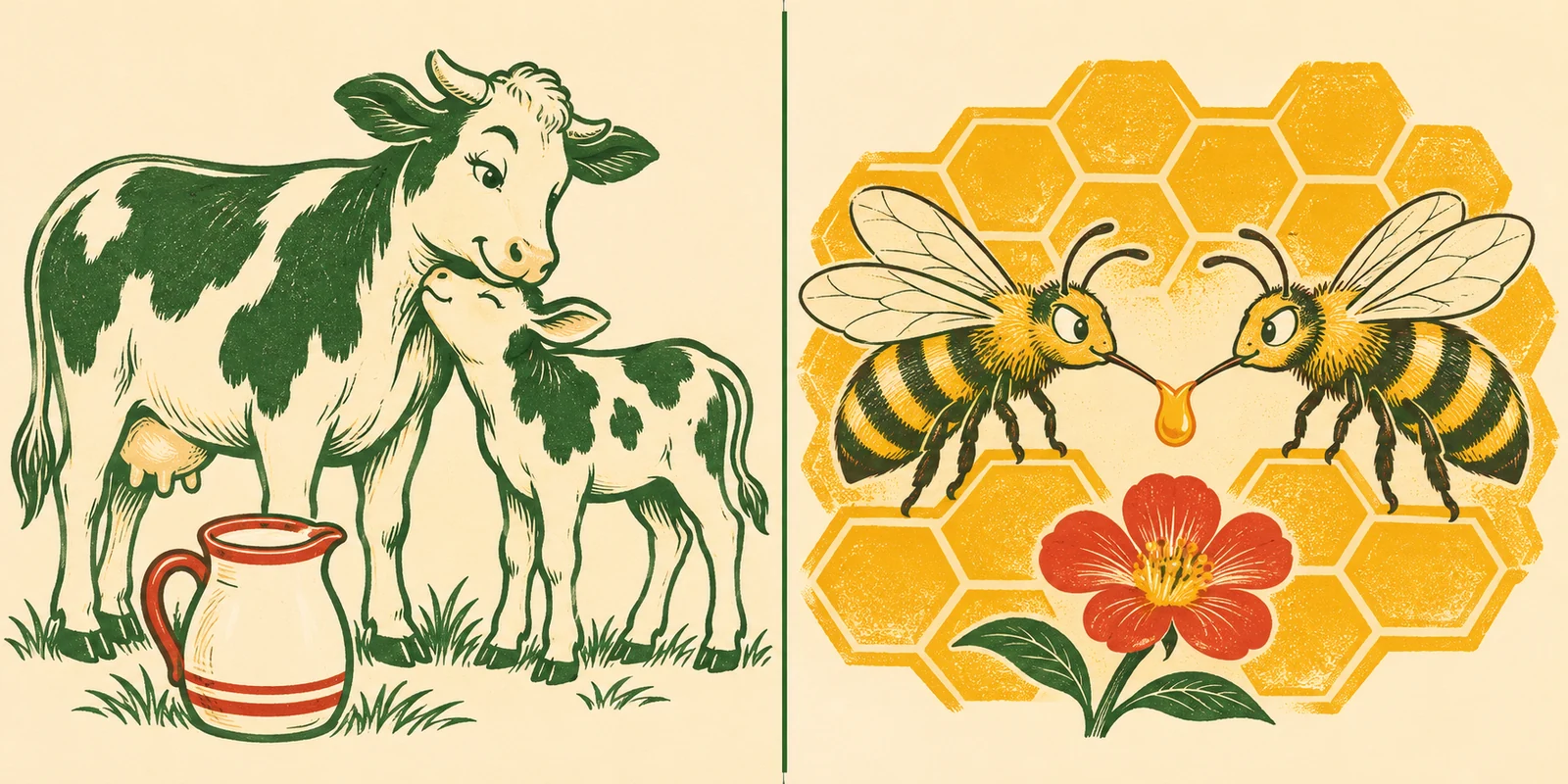
“Excuse me. That was my lunch.”
A cow makes milk for her calf after giving birth. Somewhere along the way, we decided to put it on cornflakes. The calf has a point. How lactation works
“Bug puke?” “We prefer ‘artisanal.’”
A worker bee brings nectar back up from her honey crop and passes it to a nestmate. Enzymes and evaporation turn it into honey. The bees do excellent work. We’ll have maple. How bees make honey
Milk starts in the udder.
Inside a cow’s udder are clusters of tiny sacs called alveoli. The cells lining each sac take up nutrients carried by the blood and use them to make ingredients including milk fat, protein, and lactose, the sugar in milk. They release those ingredients into the hollow center of the sac. When a calf suckles or the cow is milked, the let-down reflex squeezes milk into ducts that lead toward the teat.
Watch how cows are milked · Dairy Farmers of Ontario
See the udder anatomy diagram · University of Wisconsin Extension
Read the research review on how mammary cells make lactose
Honey starts in a flower.
A foraging bee sips nectar and carries it in her crop, a pouch often called the honey stomach. Back at the hive she can bring the nectar up and pass it mouth-to-mouth to another bee. Enzymes the bees add help split sucrose into simpler sugars. As water evaporates, the nectar thickens. Bees help that along by fanning air through the hive, then seal the ripe honey in the comb with wax.
It’s the mouth-to-mouth part for us. If you’ve just learned this and still want honey on your toast, enjoy your toast.
Watch bees make honey · PBS Be Smart
Read the field study on nectar drying · Researchers found that bees in their study had already removed water from nectar before they made it home.